
Rugby Betting for Beginners UK: From Account Setup to Your First Informed Wager
 Available in US

Everyone’s first rugby bet has a story. Mine was a tenner on Leicester Tigers to beat Northampton in a 2014 derby – I’d watched exactly one full match of Premiership rugby, picked the team with the cooler badge, and had no idea what a handicap line was. I won, which was the worst possible outcome because it convinced me I knew what I was doing. It took another six months of casual losses before I sat down and learned the mechanics properly. This guide is the one I wish I’d read before that first bet – not to stop me from placing it, but to make sure I understood what I was doing and why.
Opening a Betting Account: Verification, Deposits and Limits
Ten percent of the UK adult population bets on sport online, with 16% of men and 4% of women participating. If you’re reading this, you’re joining a substantial group of people, and the regulatory framework exists to make sure the experience is as safe as it can be. Every bookmaker operating legally in the UK holds a licence from the UK Gambling Commission, and that licence imposes specific obligations around customer protection that directly affect your account setup.
Registration takes about five minutes. You’ll provide your name, address, date of birth, and email. The operator is legally required to verify your identity – a process called KYC, or Know Your Customer – and this typically involves uploading a photo of your passport or driving licence and a recent utility bill or bank statement. The verification can take anywhere from a few minutes (if the automated check succeeds) to 48 hours (if manual review is needed). Don’t skip this or provide fake details; it’s a legal requirement, and any attempt to circumvent it will result in account closure and forfeiture of funds.

Since October 2025, all UK operators must offer you the option of setting a financial limit before you make your first deposit. I’d recommend setting one. Not a restrictive limit that kills the entertainment value, but a weekly or monthly ceiling that reflects what you can comfortably afford to lose. The limit is entirely your choice, and you can adjust it upward later – though increases typically require a 24-hour cooling-off period, which is a deliberate feature, not a flaw.

Deposit methods include debit cards, bank transfers, and e-wallets. Credit card gambling has been banned in the UK since April 2020, so don’t try. Minimum deposits vary by operator but typically sit between 5 and 10 pounds. I’d suggest starting with the minimum deposit and increasing only once you’ve placed a few bets and are comfortable with the platform.
Anatomy of a Rugby Bet: Selecting a Market, Choosing a Stake and Reading the Slip
Around 290 million online sports bets are placed monthly in the UK, and each one follows the same basic structure. Here’s how to place yours.
Navigate to the rugby section of your chosen bookmaker. You’ll see a list of upcoming fixtures, organised by competition – Premiership, Six Nations, Super League, URC, and so on. Select a match. The available markets will appear, starting with the match result and expanding into handicap, total points, tryscorer, and more. For your first bet, stick with the match result: home win, draw, or away win.
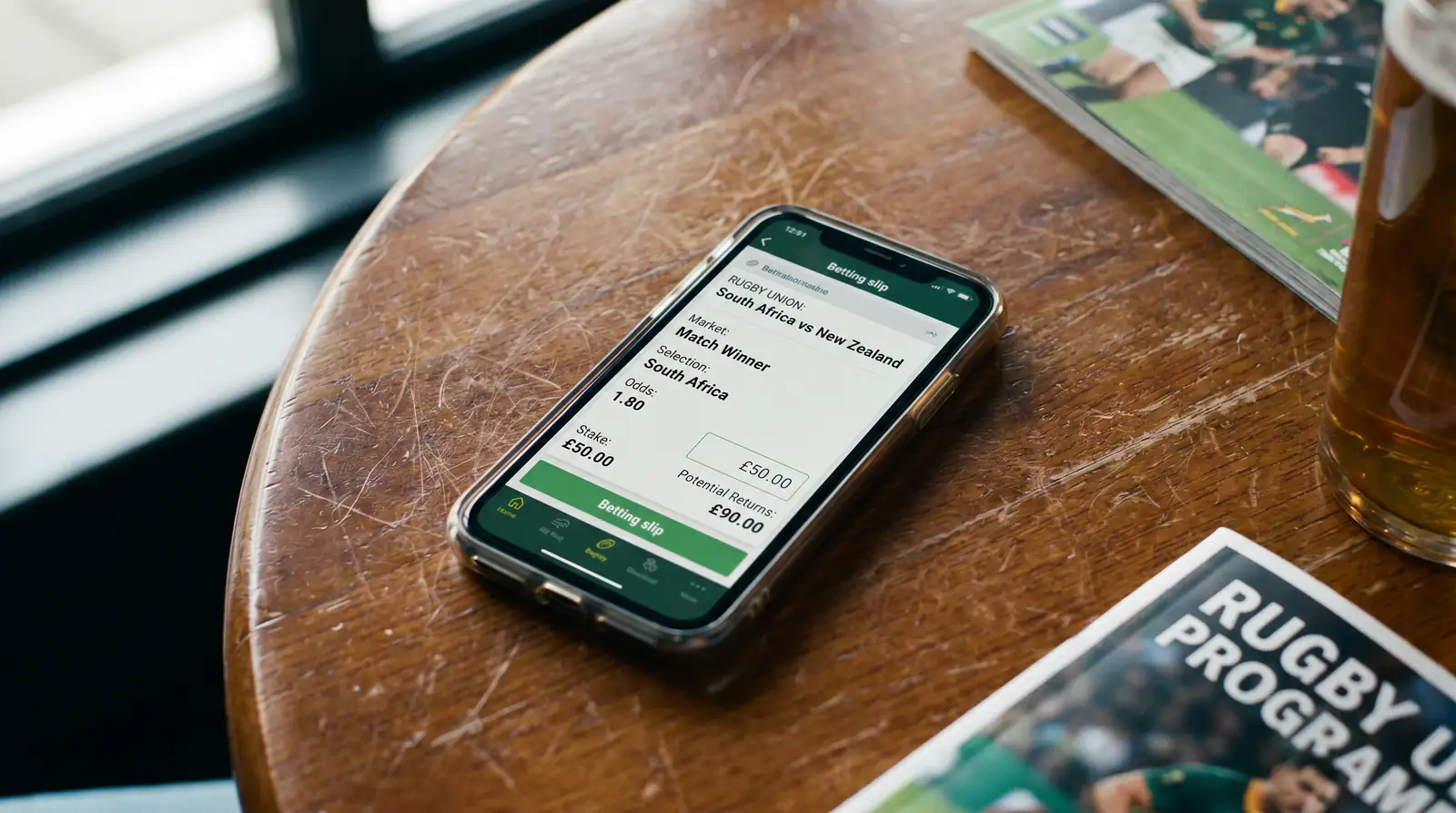
Tap or click the odds for your chosen selection. The bet appears on your bet slip – a sidebar or pop-up that shows your selection, the odds, and a field to enter your stake. Type in your stake amount. The slip will automatically calculate your potential return: stake multiplied by the decimal odds. A 5-pound bet at odds of 2.00 returns 10 pounds (5 profit plus your 5 stake). Review the details, confirm the bet, and it’s placed.

The bet slip is also where you’ll see options for multiples if you’ve added more than one selection. I’d strongly advise ignoring accumulator options for your first several weeks. Singles are how you learn, because each bet is an independent lesson in reading odds and outcomes. Accumulators compound mistakes as quickly as they compound winnings.
One practical tip: check that you’re viewing odds in the format you’re most comfortable with. Most UK operators default to fractional odds (3/1, 5/2, 4/7), but you can switch to decimal (4.00, 3.50, 1.57) in your account settings. I switched to decimal years ago and never looked back – the maths is simpler and comparison across operators is faster. If you want a deeper understanding of how odds formats work and what they encode, I’ve covered that in a separate guide on betting on rugby union.
Common Beginner Mistakes and How to Avoid Them
I’ve made every mistake on this list, so I’m speaking from experience rather than judgement. The biggest trap for new rugby bettors is betting on too many matches. The Premiership runs 18 rounds of regular-season fixtures, plus playoffs. Super League runs even longer. Add in the URC, European competitions, and internationals, and there are rugby matches available to bet on almost every weekend from September to July. Betting on all of them dilutes your analysis and inflates your turnover. I bet on three to five matches per weekend now, down from the 10 to 15 I was covering in my first year. The reduction in volume improved my results immediately.
The second mistake is chasing losses. You lose a Saturday afternoon bet, so you back something on the Sunday to “get it back”. That Sunday bet is driven by emotion, not analysis, and the probability of it winning is no higher than random selection. I use a simple rule: if my weekend allocation is spent, I stop. No exceptions. The matches will still be there next week.

The third mistake is ignoring the terms on promotions. A “free 20-pound bet” is not 20 pounds in your pocket. It’s a token that returns only the profit, not the stake, and often has minimum odds requirements and expiry dates. Read the terms before you claim anything – the five minutes you spend understanding the conditions can save you from a frustrating misunderstanding later.
The fourth mistake is betting with a single bookmaker. Different operators offer different odds on the same match, and the price gap can be 5 to 10% on some outcomes. Opening accounts with three to five UKGC-licensed bookmakers and comparing prices before every bet is the single easiest way to improve your returns. It costs nothing and takes two minutes per bet.
Start small, learn the mechanics, and treat every bet as a data point rather than a verdict on your ability. Rugby betting rewards patience and process over instinct and impulse.
How much money do I need to start betting on rugby?
Most UKGC-licensed bookmakers accept minimum deposits of 5 to 10 pounds and minimum stakes of 0.10 to 1.00 pound per bet. Starting with the minimum deposit is a sensible approach until you are comfortable with the platform, understand the markets, and have established a staking plan that reflects your entertainment budget.
What is KYC verification and why do bookmakers require it?
KYC stands for Know Your Customer and is a legal requirement for all UKGC-licensed operators. It involves verifying your identity through documents like a passport or driving licence and a proof of address. The process prevents underage gambling, money laundering, and fraud. Verification typically takes minutes if the automated check succeeds, or up to 48 hours for manual review.
Created by the ”Rugby Betting Sites” editorial team.