Rugby Total Points Over/Under: How Lines Are Set and Where to Find Soft Numbers
 Available in US
I lost count of the number of times I’ve backed the over on a Premiership match only to watch two teams grind through 60 minutes of penalty kicks and rolling mauls before someone finally scores a try. Totals betting in rugby demands patience and a specific kind of analysis that goes beyond “these two teams score a lot”. The line is usually efficient, the margin is tight enough to punish sloppy thinking, and the variables that push a match over or under are more subtle than most bettors appreciate.
How Over/Under Markets Work in Rugby
The bookmaker sets a line – say 44.5 total points for a Premiership fixture – and you bet on whether the combined final score will be over or under that number. The half-point eliminates pushes, so there’s always a result. Both sides are typically priced near evens, usually between 1.85 and 1.95, with the margin baked into the gap between the two prices. The non-racing segment of UK sports betting generated 5.05 billion pounds in 2024, and total points markets across all rugby competitions contribute a growing share of that figure.
The line itself is the bookmaker’s best estimate of the combined score, adjusted slightly to balance the money on each side. In the Premiership, opening lines for most matches fall between 40.5 and 55.5. Six Nations matches tend to sit lower – international defence is tighter, the tempo is slower, and the average total across recent editions has hovered around 42 to 44 points. Super League matches run higher because rugby league’s rules produce faster play and more frequent scoring.
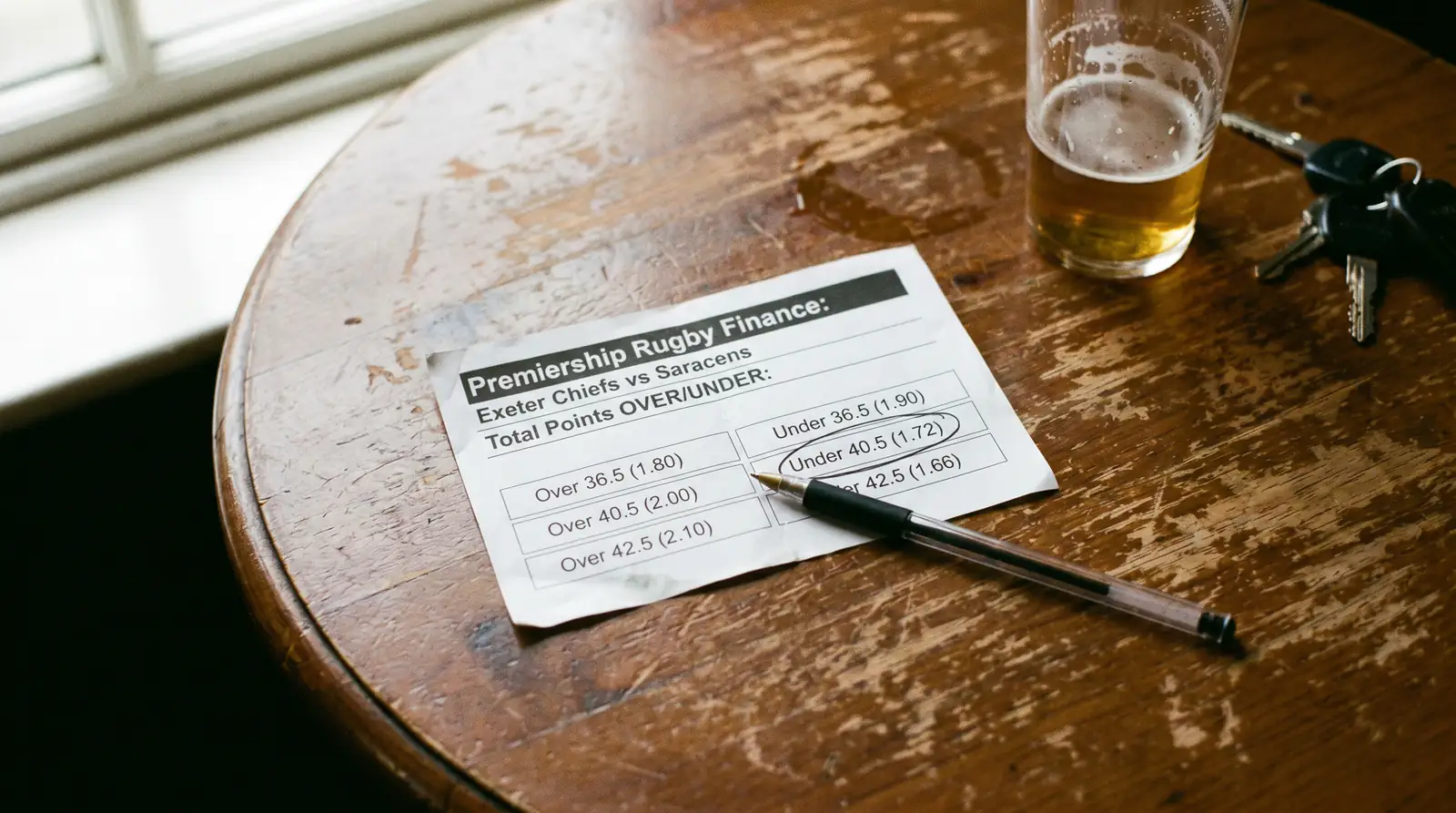
Alternative totals give you more precision. Instead of the main line at 44.5, you might see options at 34.5, 39.5, 49.5, and 54.5, each at different odds. The lower the line, the shorter the over price (more likely to go over a low number) and the longer the under. I use alternative totals when my model gives a strong directional view – if I’m confident the total will land between 48 and 55, I’ll take the over at 44.5 on the main line and add a smaller position on over 49.5 at longer odds for a better risk-reward profile.
What Drives Total Points Lines: Weather, Venue and Style of Play
Weather is the single most underrated input in total points modelling, and it’s the one that gives me the most consistent edge. A heavy rain forecast compresses scoring by increasing handling errors, reducing the accuracy of long passes, and pushing both teams toward conservative, territory-based gameplans. I check the Met Office hourly forecast for each venue starting 48 hours before kick-off and adjust my total points estimate downward by 4 to 8 points for matches where sustained rain or strong wind is expected.
Wind deserves separate attention. A strong crosswind at a ground like Sandy Park or the Stoop makes place-kicking more difficult, which reduces the expected return from penalties. But it doesn’t reduce tries proportionally, because teams compensate by running more. The net effect on total points depends on whether the reduced kicking accuracy costs more points than the increased running creates. In my data, strong wind tends to reduce totals by 3 to 5 points overall, with most of that reduction coming from missed conversions and penalties rather than fewer tries.

Venue effects are real and persistent. Some Premiership grounds consistently produce higher-scoring matches due to pitch dimensions, surface quality, and local conditions. I maintain a venue-scoring index that tracks the average total points at each ground over a three-season rolling window. The differences are meaningful – the highest-scoring Premiership venue averages 6 to 8 points per match more than the lowest, even after adjusting for the home team’s playing style.

Playing style is the variable that most bettors consider first, and rightly so. A match between two expansive, try-scoring teams pushes the expected total up. A match between two defence-first teams with strong set pieces pushes it down. But the interaction between styles matters more than the individual styles. A free-flowing attacking team against an aggressive rush defence often produces fewer points than expected, because the rush defence forces errors and turnovers that neither team’s historical scoring average accounts for.
Alternative Total Lines and Half-Time/Full-Time Totals
Around 290 million online bets are placed monthly in the UK, and the growth in alternative total lines reflects the demand for more granular options within the totals market. Half-time totals – where you bet on the combined score at the 40-minute mark – offer a different proposition from full-match totals. First halves in rugby union tend to be tighter than second halves, because teams play more conservatively while feeling out the opposition and the conditions. My data shows first-half scoring in the Premiership averages about 42 to 44% of the final total, meaning a match with a full-time line of 44.5 would have an implied first-half line of roughly 19 to 20.
Individual team totals are another variant: you bet on whether a specific team will score over or under a set number of points. These markets carry slightly wider margins than combined totals, but they reward team-specific analysis. If I have a strong view on one team’s scoring output but less confidence about the opponent’s, an individual team total lets me express that view without the noise of the other side’s performance.
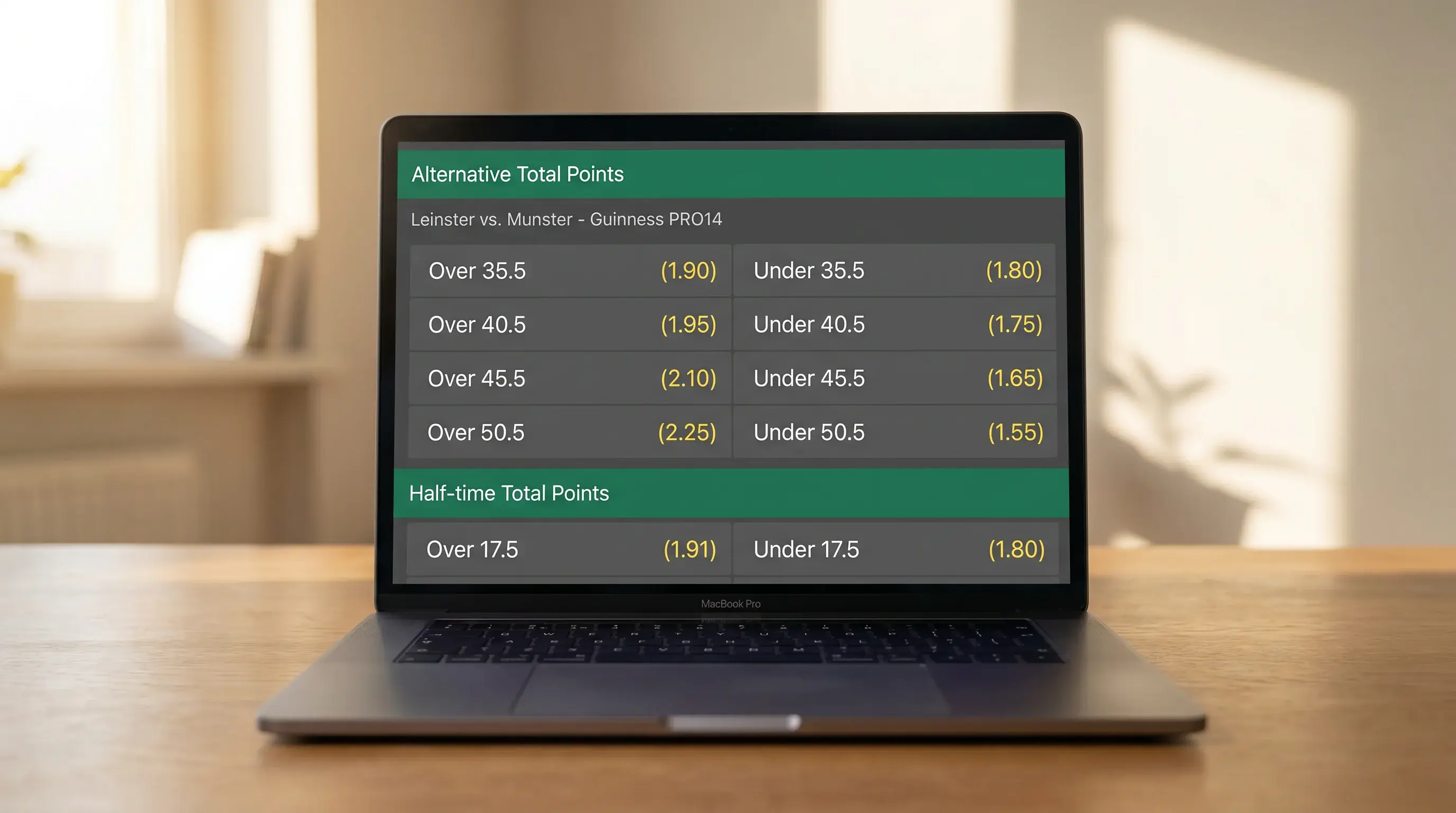
Try totals – over/under a set number of total tries in the match – strip out the kicking component entirely. A match can hit the over on total points through penalties while missing the try total under, or vice versa. Try totals are particularly useful in matches where one team has an elite kicker but a weaker try-scoring record, because the points total might go over while the try count stays low. Separating these two variables is one of the clearest advantages of the modern multi-market rugby offering.
What impact do weather conditions have on rugby total points betting?
Heavy rain typically reduces total points by 4 to 8 compared to dry conditions, primarily through increased handling errors and more conservative tactics. Strong wind reduces totals by 3 to 5 points, mainly through missed place kicks rather than fewer tries. Checking the hourly forecast for each venue 48 hours before kick-off is an essential step in total points analysis.
What is a typical over/under line for a Premiership match?
Most Premiership fixtures are lined between 40.5 and 55.5 total points, depending on the teams and conditions. The average across a full season sits around 45 to 48 points. Six Nations matches tend to be lined lower at 40 to 44 due to tighter international defence, while Super League matches run higher due to the faster pace of rugby league.
Prepared by the Rugby Betting Sites editorial staff.