Rugby Betting Analysis
Best UK Rugby Betting Sites in 2026: Data-Driven Rankings and Analysis
By Rugby Betting Analyst
 Available in US

Table of Contents
- Best UK Rugby Betting Sites in 2026: Data-Driven Rankings and Analysis
- Eleven Years Distilled: What Actually Decides Where Your Rugby Money Goes
- How We Evaluate and Rank Rugby Betting Sites
- The Highest-Rated Rugby Bookmakers for UK Punters
- Rugby Union vs Rugby League: Why the Distinction Matters for Betting
- Core Betting Markets Every Rugby Punter Should Know
- Reading Odds and Understanding Bookmaker Margins
- Rugby Margin & Score Calculator
- Welcome Bonuses and Free Bets: What to Expect in 2026
- Live Betting and Mobile Apps for Rugby
- UKGC Licensing and the Regulatory Landscape
- Responsible Gambling Tools and Resources
- Frequently Asked Questions
Best UK Rugby Betting Sites in 2026: Data-Driven Rankings and Analysis
I placed my first rugby bet in 2015 – a handicap line on a Premiership match that I’d studied for all of twenty minutes. The bookmaker’s margin ate my edge before the whistle blew, and I spent the next decade learning why. Eleven years of tracking odds across Union and League fixtures taught me that most “best rugby betting sites” lists are built on affiliate commissions, not analysis. This page is my attempt to fix that.
The UK online gambling market hit $8,284 million in 2025, and rugby’s slice of that pie keeps growing. Global rugby wagering turnover crossed the EUR600 million mark in 2023, driven by expanding in-play markets, deeper coverage of competitions like the Premiership and Super League, and a younger audience that treats match-day betting as part of the viewing experience. The numbers are big. The question is whether punters are getting a fair deal from the platforms collecting those numbers.
What you’ll find here is not a list of logos with star ratings. I evaluate rugby betting sites the way I evaluate odds themselves – through measurable criteria. Margin percentages across match result, handicap and total points markets. The actual number of rugby-specific markets available on a Saturday afternoon in February. Whether an operator’s live betting interface can keep up with the pace of a Six Nations half. Whether bonuses survive their own terms and conditions.
I also cover territory that no other site in this niche touches: the impact of the Remote Gaming Duty increase to 40% on your payouts, what the Premiership’s shift to a franchise model means for relegation markets, and how IBIA integrity monitoring protects the rugby betting ecosystem from the inside. If a claim appears on this page, it’s backed by a number, a regulation, or a decade of personal observation. If it isn’t, I’ve cut it.
This guide is written for UK punters who bet on rugby – or want to start – and prefer evidence over enthusiasm. Whether you follow Union or League, whether you back match results or build tryscorer accumulators, the framework here applies. Let’s get into it.
Eleven Years Distilled: What Actually Decides Where Your Rugby Money Goes
- Bookmaker margins on rugby markets vary by 3-5 percentage points between operators – odds shopping on a single Six Nations match can recover more value than any welcome bonus.
- The Remote Gaming Duty jump from 21% to 40% in April 2026 is already tightening odds and shrinking promotions, with the government projecting operators will pass up to 90% of that cost to punters.
- Union and League are different sports for betting purposes: scoring systems, handicap structures and market depth diverge sharply, and backing the wrong code with the wrong strategy is a reliable way to lose.
- Live betting accounts for roughly 30% of all UK sports wagers, and over 70% of bets are placed on mobile – if your bookmaker’s app lags during a scrum reset, you’re trading at a disadvantage.
- UKGC licensing is non-negotiable. Mandatory deposit limits before first play, GamStop self-exclusion, and operator-funded integrity monitoring are baseline protections, not extras.
How We Evaluate and Rank Rugby Betting Sites
Three years ago I sat down with a spreadsheet containing every rugby bet I’d placed since 2017 – 2,400 wagers across Premiership, Six Nations, Super League and assorted internationals. The pattern was uncomfortable: my strike rate was decent, but my returns were mediocre because I’d been lazy about where I placed those bets. Two operators were quietly costing me 2-3% on every handicap market through wider margins. That spreadsheet became the foundation of the evaluation framework I use today.
The total gross gambling yield for the UK industry reached GBP15.63 billion in the year to March 2024, a 5.7% year-on-year increase. Within that, the non-racing segment – which includes rugby – generated GBP5.05 billion in revenue in 2024 alone, making it the single largest category in UK sports betting. These aren’t niche numbers. Rugby betting is a substantial market, and operators treat it accordingly. The question is whether they treat punters accordingly too.
What “ranking” means here – I don’t assign a single score and call it a day. Each operator is assessed across five weighted dimensions: margin efficiency (how much the bookmaker takes from each market), market depth (total number of rugby-specific markets on a typical match day), live betting performance (latency, available in-play markets, cash-out reliability), bonus real value (what a welcome offer is actually worth after wagering requirements), and regulatory compliance (UKGC licence status, responsible gambling tools, data protection). No dimension gets less than 10% weight, and margin efficiency gets the most because it affects every single bet you place.
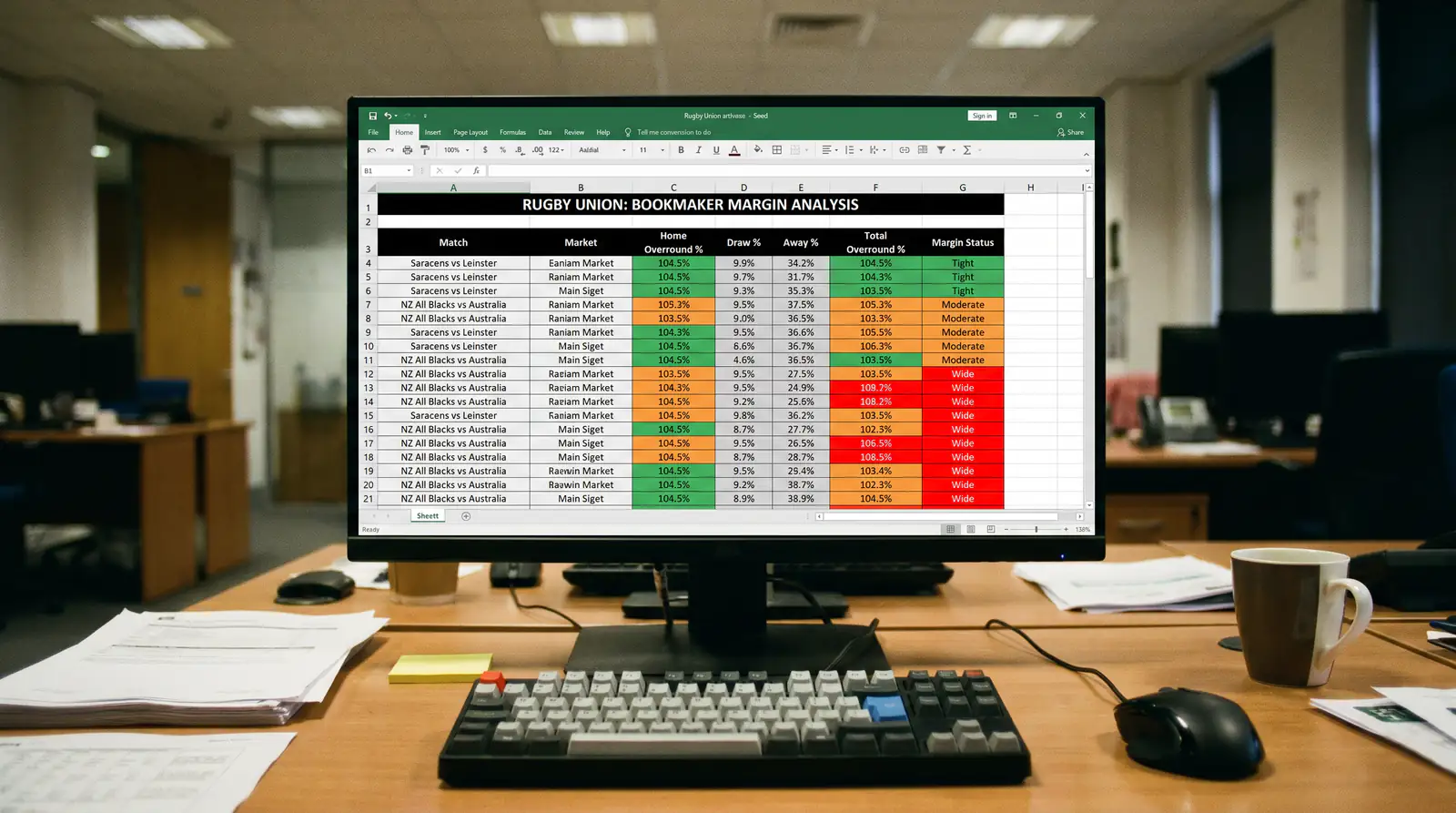
I check margins the way I learned to check them from the old-school tipsters who mentored me early on: by calculating the implied probability of each outcome in a market, summing those probabilities, and measuring the excess above 100%. A market priced at 103% is taking 3% from every pound staked. That sounds small until you multiply it across a season’s worth of Saturday accumulators. Margin checks happen across three market types per operator – match result, handicap, and total points – because some bookmakers price one market tightly and inflate another to compensate.
Market depth is straightforward but surprisingly hard to verify without doing the work yourself. I count markets on a live fixture, not on a hypothetical “up to 150 markets” claim buried in marketing copy. A Premiership match between two mid-table sides on a wet Saturday afternoon is the real test, not a Six Nations final with global attention. Operators that maintain deep market lists on low-profile fixtures are the ones investing in rugby-specific pricing teams, and that investment shows in the quality of their odds.
Most comparison sites treat rugby as a footnote under “other sports.” My framework gives rugby-specific performance equal weight to football-centric metrics. If a bookmaker excels at football markets but phones in its rugby offering, that shows up in the scores.

Live betting performance is tested during actual matches. I open the same fixture on multiple platforms simultaneously and compare how quickly odds update after a try, a penalty, or a yellow card. A two-second delay on a handicap line adjustment during a tight Six Nations second half is the difference between catching value and chasing a price that’s already moved.
Bonus evaluation requires a calculator, not a headline. A GBP30 free bet with 3x wagering at 1.50 minimum odds has an effective value of roughly GBP10 after required turnover. I calculate the expected real value of every welcome offer and ongoing promotion, because the gap between the advertised figure and what you’ll actually extract is where operators make their margin on new customers.
Regulatory compliance is the baseline, not a bonus. Every operator I assess must hold a current UKGC licence. I also check whether responsible gambling tools are prominent or buried, whether deposit limit prompts appear before the first transaction (as required since October 2025), and whether the operator participates in industry integrity programmes.
The Highest-Rated Rugby Bookmakers for UK Punters
Every January, I reset my tracking spreadsheet and start fresh. New season, new promotions, new platform updates – and occasionally a new operator entering the rugby space that wasn’t there the year before. By February, when the Six Nations starts generating serious volume, I’ve got enough live data to separate the platforms that invested in rugby over the off-season from those that simply recycled last year’s market templates. What follows is how the current landscape breaks down across the five dimensions I outlined above, without naming a “winner” – because the best site for you depends on how you bet.
Around 290 million online bets on real events are placed monthly in the UK. That volume creates genuine competitive pressure among operators, and the ones that respond with tighter margins and deeper rugby coverage earn their place in any serious bettor’s portfolio. I use the word “portfolio” deliberately: limiting yourself to a single bookmaker is the fastest way to guarantee you’re leaving value on the table.
What Top-Scoring Operators Share
Match result margins consistently below 4.5% on Premiership fixtures. Handicap markets available on all televised Union and League matches. Live betting with sub-3-second odds refresh on rugby. Cash-out offered on singles and accumulators, including partial cash-out. Welcome offers with effective real value above GBP15 after wagering. Dedicated rugby section – not rugby buried under “other sports.”
Where Mid-Tier Operators Fall Short
Margins above 5.5% on handicap markets. Fewer than 30 markets per match on non-televised fixtures. No in-play rugby markets outside the top-flight. Free bet offers with 5x+ wagering requirements that reduce real value below GBP8. Rugby mixed in with niche sports rather than given its own navigation.

The gap between the top tier and the middle tier is not dramatic on any single bet. It’s cumulative. Over a season of, say, 100 bets at GBP20 average stake, a margin difference of 1.5 percentage points costs roughly GBP30 – more than most welcome bonuses are worth in real terms. That’s the maths that matters, and it’s why margin efficiency carries the heaviest weight in my framework.
Live betting is where the differentiation becomes visceral. I’ve sat through second halves where one operator’s handicap line adjusted within a second of a try being scored while another platform still showed the pre-try price for a full four seconds. In a sport where momentum swings happen fast – a yellow card, a penalty try, a sin-binning during a decisive scrum – those seconds represent real money. The operators investing in proprietary technology stacks, rather than relying on third-party feeds, are the ones delivering the best live experience. If your operator’s rugby live interface wasn’t built for mobile-first usage, you’re at a structural disadvantage before the match even starts.
| Evaluation Criterion | Top Tier (Score 8-10) | Mid Tier (Score 5-7) | Below Average (Score 1-4) |
|---|---|---|---|
| Match result margin (Premiership) | Below 4.0% | 4.0% – 5.5% | Above 5.5% |
| Handicap margin (Six Nations) | Below 4.5% | 4.5% – 6.0% | Above 6.0% |
| Markets per match (mid-table Premiership) | 80+ | 40 – 79 | Below 40 |
| Live odds refresh speed | Under 2 seconds | 2 – 4 seconds | Over 4 seconds |
| Welcome offer real value (after wagering) | GBP15+ | GBP8 – GBP15 | Below GBP8 |
| Responsible gambling tool visibility | Pre-login prompt + dedicated page | Footer link + account settings | Buried or hard to find |
Market depth deserves its own comment. An operator advertising “120+ markets” on a Six Nations match might be padding that number with obscure permutations nobody bets on – exact score at half-time combined with total penalties in the second half. I count only markets a serious rugby bettor would realistically consider: match result, handicap (multiple lines), total points (multiple lines), first and anytime tryscorer, winning margin bands, half-time/full-time, player points, and team-specific props. If an operator offers 90 markets but only 35 fall into these usable categories, the real depth score reflects 35.
How margin differences play out on a real bet
Suppose you’re backing the home side in a Premiership match. Operator A prices the home win at 1.85, the away win at 2.10, and the draw at 21.00. The implied probabilities sum to 103.8% – a 3.8% margin. Operator B prices the same fixture at 1.80, 2.00, and 19.00 – summing to 106.3%, a 6.3% margin. On a GBP50 stake at Operator A, your expected return is GBP92.50. At Operator B, it’s GBP90.00. That GBP2.50 gap on a single bet multiplied across a season tells the whole story.

I don’t rank individual operators by name on this page because the landscape shifts every quarter. Promotions change, odds compilers move between firms, and platform updates can transform an average live experience into a strong one overnight. The comparison table above is the lens – point it at any UKGC-licensed bookmaker offering rugby markets and you’ll have an accurate read within ten minutes of checking their prices on a live fixture.
Rugby Union vs Rugby League: Why the Distinction Matters for Betting
I once watched a friend lose a four-fold accumulator because he’d applied Union logic to a League fixture. He’d backed the under on total points in a Super League match using the same threshold he’d use for a Premiership game, forgetting that League’s faster pace and four-point tries reliably produce higher-scoring contests. It was an expensive lesson in a point I’ve been making for years: Union and League are different sports with different betting architectures, and treating them interchangeably is a structural error.
The differences start with the rules and cascade into every market. Union plays 15-a-side with tries worth five points, conversions worth two, penalties and drop goals worth three. League plays 13-a-side with tries worth four points, conversions worth two, penalties worth two, and drop goals worth one. That scoring gap changes everything about how total points lines are set, how handicaps behave, and where value tends to hide. In Union, set-piece dominance and kicking accuracy can keep scores tight; in League, the structured play-the-ball system creates more open-field try-scoring opportunities and pushes totals higher.
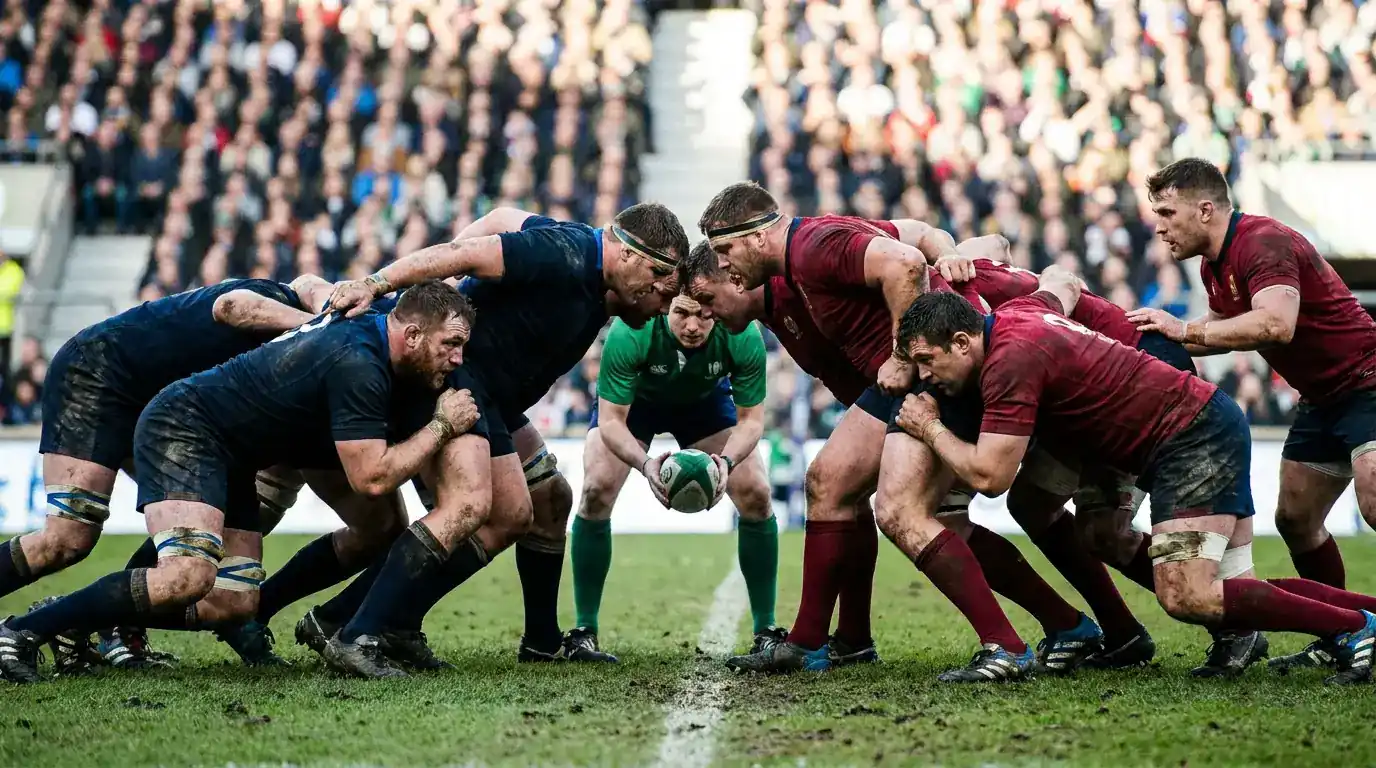
Competition structures at a glance – Premiership Rugby, the top Union league in England, is transitioning to a franchise model from the 2026/27 season, eliminating automatic promotion and relegation. That shift kills the relegation betting market entirely and reshapes outright odds. Super League, the top League competition, is expanding to 14 clubs from 2026, adding new fixtures and new betting opportunities. Meanwhile, the international calendar serves both codes differently: Six Nations (Union) dominates February to March, while League’s international window clusters around the autumn. Knowing which code is in season – and which competitions are generating betting volume – is fundamental to finding sharp odds.
The audience and commercial trajectory of each code affects betting markets in ways most punters overlook. Premiership Rugby secured a five-year TV deal extension with TNT Sports worth approximately GBP200 million, and total viewership across 13 rounds grew 11% year-on-year. Alex Cadwallader of Leonard Curtis put it well when he noted that Premiership rugby in England delivers dramatic, entertaining sport with genuine competitive balance – five different winners in the past five seasons. That competitive balance directly translates into tighter odds and more interesting handicap markets. Super League, meanwhile, is navigating the expiry of its Sky Sports contract at the end of 2026, with Betfred’s title sponsorship already in its final year of the current cycle. These commercial shifts influence how much liquidity each code attracts from bookmakers, and liquidity drives market depth.
For a detailed breakdown of the best rugby union betting sites with Premiership and Six Nations-specific analysis, I’ve built a dedicated evaluation. Similarly, if League is your code, the best rugby league betting sites guide covers Super League, Challenge Cup and NRL market availability across UK operators.
Do
- Maintain separate bankrolls or at least separate tracking for Union and League bets – the variance profiles differ
- Adjust your total points expectations downward for Union (especially tight Premiership fixtures) and upward for League
- Check which code a bookmaker prioritises before opening an account – some operators invest heavily in Union pricing but treat League as secondary
- Follow the competition calendar to know when each code is generating peak betting volume and tighter odds
Don’t
- Apply the same handicap sizing logic across both codes – a -7.5 line means something very different when tries are worth four points instead of five
- Assume a bookmaker that excels at Union will automatically offer competitive League odds, or vice versa
- Ignore the commercial context – TV deals, sponsorships and franchise restructuring all reshape the markets you’re betting into
- Treat “rugby betting” as a single category in your records – the sports are distinct and your analysis should reflect that

Understanding the Union/League split is the structural foundation. The next step is knowing what you can actually bet on once you’ve picked your code and your operator.
Core Betting Markets Every Rugby Punter Should Know
When I started betting on rugby, I stuck to match results for two full seasons. Win or lose, that was it. It took an embarrassingly long time to realise I was ignoring the markets where the real value lived – and where bookmakers priced less efficiently because fewer punters were looking. The vast majority of rugby bets cluster around the obvious outcomes. The edges sit in the markets with less traffic.
Here’s a map of the core markets available on most UKGC-licensed rugby betting sites, starting with the ones that attract the most volume and moving toward the less obvious options where an informed bettor can find more favourable pricing.
Match Result – the simplest market: which team wins (or, in Union, whether the match ends in a draw). Bookmakers price this most efficiently because it attracts the highest volume, so margins tend to be tightest here. In League, draws are rare enough that many operators offer only a two-way market (home/away), folding the draw into a dead-heat rule.
Handicap – one team receives a virtual point advantage or deficit. A -7.5 handicap on the favourite means they must win by 8 or more points for the bet to land. This is the bread-and-butter market for serious rugby bettors because it levels mismatched fixtures and forces you to assess the margin of victory, not just the winner. Handicap pricing varies significantly between operators – I’ve seen 2-point differences in the line offered on the same League fixture.
Total Points (Over/Under) – a line is set for the combined score of both teams, and you bet whether the actual total lands above or below it. Weather, venue, and the tactical approach of both sides all influence where the line sits. A windy Premiership fixture at a coastal ground will carry a lower total than the same teams meeting at Twickenham on a calm day. Alternative lines at 0.5-point increments give you flexibility to adjust the price/probability trade-off.
Tryscorer – first, last, and anytime tryscorer markets. First tryscorer pays the highest odds because it’s the hardest to predict; anytime tryscorer offers lower prices but significantly higher strike rates. This market rewards punters who study team selection, positional tendencies, and recent try-scoring form rather than just headline stats.
Winning Margin – instead of picking the winner, you bet on the band within which the winning margin falls (e.g., home by 1-12 points, away by 13+). This market is underpriced on fixtures where analysts expect a tight contest but the bookmaker’s bands are set wide.

Outright / Ante-Post – tournament or season-long bets on the overall winner, top tryscorer, or other cumulative outcomes. Six Nations winner, Premiership champion, Super League Grand Final winner. Odds are available months in advance and shift as the competition progresses. Early prices often contain more value than match-day odds because the bookmaker is pricing with less information.
Putting it together: a Six Nations Saturday
Suppose England host France. Your bookmaker offers: match result (3-way), handicap at -3.5 and -6.5 for England, total points at 42.5, 45.5 and 48.5, first tryscorer (20+ players), anytime tryscorer, winning margin in four bands, half-time result, and half-time/full-time double result. On a high-profile fixture like this, a well-stocked operator might list 80-100 individual markets. Drop down to a midweek Premiership fixture between two lower-table sides and that number might halve – which is precisely why market depth on unglamorous fixtures is a better test of an operator’s commitment to rugby.
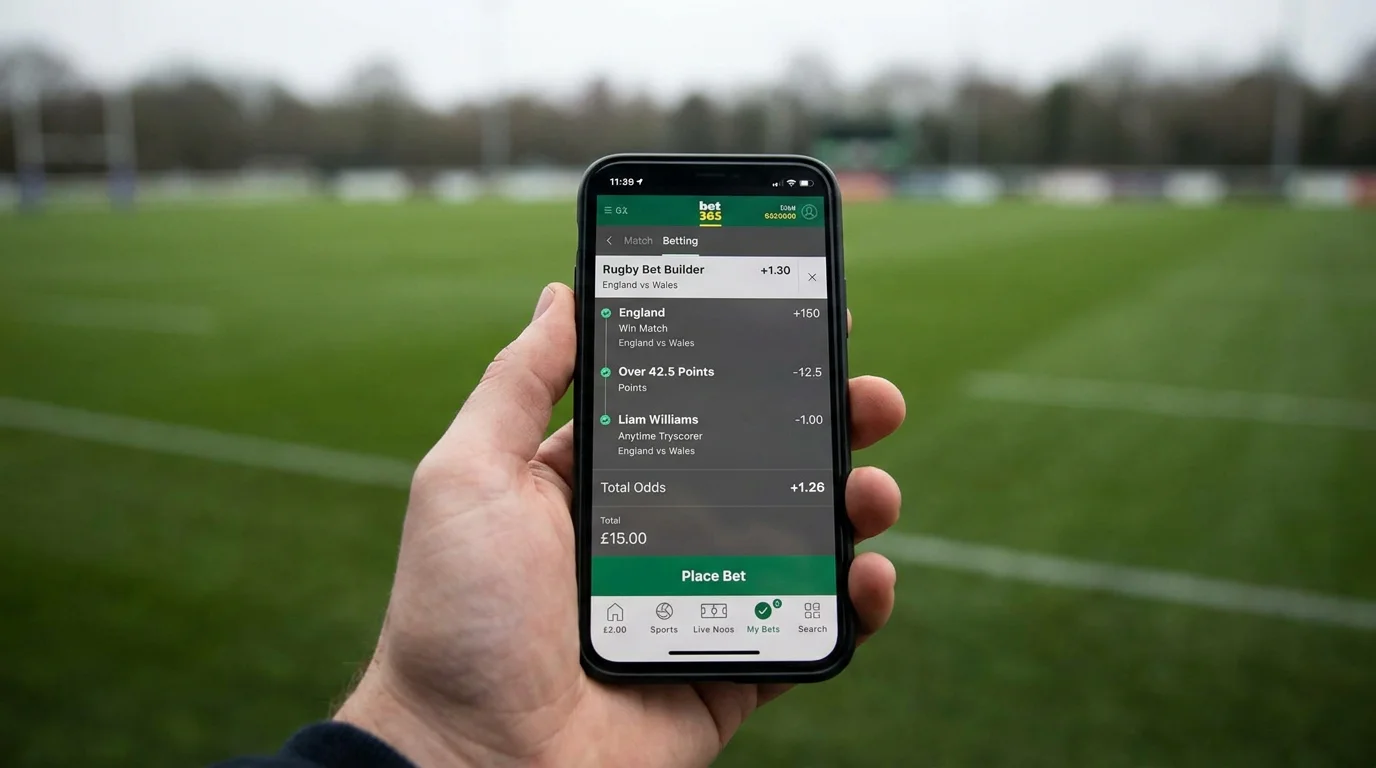
Bet builders – same-game multiples – deserve a brief mention for their growing popularity. They let you combine selections from within a single match into one bet at a combined price: home win, over 42.5 total points, and a specific player to score anytime, all on one slip. The prices look attractive, but the correlation between these outcomes means the true probability is higher than the combined odds suggest, and the bookmaker’s margin on bet builders tends to be significantly wider than on standalone markets.
Cash-out, available on most markets from most UKGC-licensed operators, lets you settle a bet before the event finishes. The offered cash-out price always includes a margin – you’re paying for the privilege of certainty. It’s useful for managing risk during live matches, but it’s not free money.
Reading Odds and Understanding Bookmaker Margins
Here’s a number that should change how you think about every rugby bet you place: the UK government projects that operators will pass up to 90% of gambling tax increases through to consumers via higher prices or reduced payouts. That projection comes from HMRC’s own policy paper on gambling duties. The mechanism is the margin baked into every set of odds, and understanding how it works is the single most valuable skill a rugby bettor can develop.
Most UK bookmakers display odds in fractional format (5/2, 4/1) or decimal format (3.50, 5.00). Both express the same thing: the implied probability the bookmaker assigns to an outcome, plus their cut. Converting decimal odds to implied probability is simple – divide 1 by the decimal price. Odds of 2.00 imply a 50% chance; odds of 3.00 imply 33.3%. Add up the implied probabilities of all outcomes in a market, and the total exceeds 100%. That excess is the margin.
Margin calculation on a Union handicap market
Home -5.5 is priced at 1.91. Away +5.5 is priced at 1.91. Implied probability: 1/1.91 = 52.36% per side. Total: 104.72%. The margin is 4.72%. For every GBP100 wagered across both sides of this market, the bookmaker expects to retain GBP4.72 regardless of outcome. Now imagine the same market priced at 1.87 each side: total implied probability is 106.95%, a margin of 6.95%. That 2.23-percentage-point difference costs you real money over time.
TryLine · Toolkit
Rugby Margin & Score Calculator
Measure the margin baked into any price, simulate a Union or League scoreline, and see what shopping your odds saves across a season.
Convert each price to its implied probability, sum them, and read the excess over 100% — the bookmaker’s margin.
Build a scoreline from tries and kicks — the calculator applies the right point values for each code, then tests your total and handicap lines.
Home
Away
The margin gap between two bookmakers looks tiny on one bet. Across a season it dwarfs most welcome bonuses. See your own number.
The margin story just got more expensive for UK punters. Remote Gaming Duty increased from 21% to 40% in April 2026, nearly doubling the tax operators pay on their online gaming revenue. A new 25% remote betting duty follows in April 2027, replacing the current 15% rate. Neal Menashe, CEO of Super Group, responded to the announcement by acknowledging support for reasonable taxation while calling for strict enforcement against offshore operators who avoid paying altogether. The subtext is clear: licensed operators absorb higher costs and pass them on; unlicensed operators undercut them. For punters, this means the margins you see on rugby odds are likely to widen further over the next 18 months, making odds shopping even more critical than it already was.
The practical takeaway: if you’re placing rugby bets with a single operator, you’re almost certainly paying more margin than necessary. Opening accounts with three or four UKGC-licensed bookmakers and checking prices before each bet takes five minutes per wager and saves more over a season than any single promotion or bonus. This isn’t theory – it’s what every professional and semi-professional bettor I know does as a matter of routine.

One pattern I’ve observed across eleven years of tracking: margins on rugby match result markets tend to be tighter than on handicap or total points markets, because match result attracts the highest volume and the most price-sensitive punters. Handicap margins run 0.5-1.5 percentage points wider, and tryscorer markets – where pricing is more subjective and volume is lower – can carry margins of 8-15%. If you’re building an accumulator from tryscorer selections, the compounded margin across four or five legs can exceed 30%. That’s not a bet; it’s a donation. Knowing which markets are priced efficiently and which are inflated helps you allocate your stakes where the maths is least hostile.
Welcome Bonuses and Free Bets: What to Expect in 2026
Don’t judge a bonus by its headline number. The GBP40 free bet that requires 5x wagering at minimum odds of 2.00 is worth less than the GBP20 free bet with 1x wagering at minimum odds of 1.50. The maths isn’t complicated, but the marketing is designed to make you skip it. The UK betting market employs over 91,000 people across 914 companies, and a significant portion of those people work on making promotional offers look more attractive than they are.
The standard bonus types you’ll encounter on rugby betting sites fall into four categories, and the real value of each depends entirely on the terms attached.
| Bonus Type | Typical Headline | Common Terms | Effective Real Value |
|---|---|---|---|
| Free bet (stake not returned) | GBP30 free bet on rugby | 3x wagering, min odds 1.50, 7-day expiry | GBP8 – GBP12 |
| Free bet (stake returned) | GBP20 risk-free first bet | Refund as free bet if first bet loses, 1x wagering on refund | GBP12 – GBP16 |
| Matched deposit | 100% up to GBP50 | 5x wagering on deposit + bonus, min odds 1.80 | GBP6 – GBP10 |
| Enhanced odds | England to win at 6.00 (was 1.40) | Max stake GBP5, winnings paid as free bets | GBP3 – GBP8 |
The numbers in the “Effective Real Value” column are based on my calculations across dozens of offers I’ve personally tested. The methodology: take the bonus amount, divide by the wagering multiplier, and adjust for the probability of meeting minimum odds requirements on typical rugby markets. A GBP30 free bet with 3x wagering at 1.50 minimum odds requires GBP90 in qualifying turnover. At an average margin of 4%, you’ll lose roughly GBP3.60 in margin cost during the wagering process, leaving the free bet’s net contribution at around GBP10.
The timing of your sign-up matters more than most punters realise. Operators routinely enhance their rugby welcome offers during the Six Nations window (February-March) and around Premiership finals. I’ve tracked seasonal patterns where the same operator’s standard GBP20 free bet swells to GBP40 during peak rugby weekends, with identical wagering terms. Patience can literally double the value of your welcome bonus.

Tax changes are squeezing bonus generosity. With Remote Gaming Duty nearly doubling, operators face higher costs on every pound of promotional spending. The government’s own projections suggest most of this increase passes through to consumers, and the promotional budget is one of the easiest levers to pull. I’ve already observed a shift: where GBP50 matched deposits were common in 2024, GBP30 is becoming the new ceiling for many operators in 2026. Free bet expiry windows are shortening from 30 days to 7 days. Minimum odds requirements are creeping upward. The trend is clear, and it favours punters who understand the real value maths over those chasing headline numbers.
For a comprehensive breakdown of every current rugby free bet and sign-up offer – including my effective value calculations for each – see the dedicated rugby free bets UK guide, which I update each time a major operator changes its terms.
Live Betting and Mobile Apps for Rugby
Live Betting and Mobile Apps for Rugby
ations match, I placed a live handicap bet on my phone while standing in a pub in Bath. The app took four seconds to confirm the bet. In those four seconds, Ireland scored from a turnover and the line moved three points against me. The bet was confirmed at the old price – which worked in my favour that time – but the experience crystallised something I’d been tracking for years: live rugby betting is only as good as the technology delivering it, and technology means mobile.
The numbers back this up. Roughly 30% of all online sports bets in the UK are placed in-play, and over 70% of all wagers come through mobile devices. Those two trends converge on rugby more intensely than on most other sports because rugby’s match flow creates natural betting windows – the pause after a try while the conversion is taken, the reset after a scrum penalty, the build-up to a line-out in the opposition 22. Punters who can read these windows and execute quickly on a well-designed app have a genuine edge over those stuck on a desktop browser or fighting a sluggish interface.
The quality of a rugby betting app is not about aesthetics – it’s about execution speed during the moments that matter. A clean home screen means nothing if the in-play odds take five seconds to load after a penalty is awarded. The features that separate strong rugby apps from weak ones are all functional: odds refresh latency under two seconds, one-tap bet placement from the in-play view, push notifications for odds movements on pre-selected fixtures, and cash-out that executes at the displayed price without requoting.
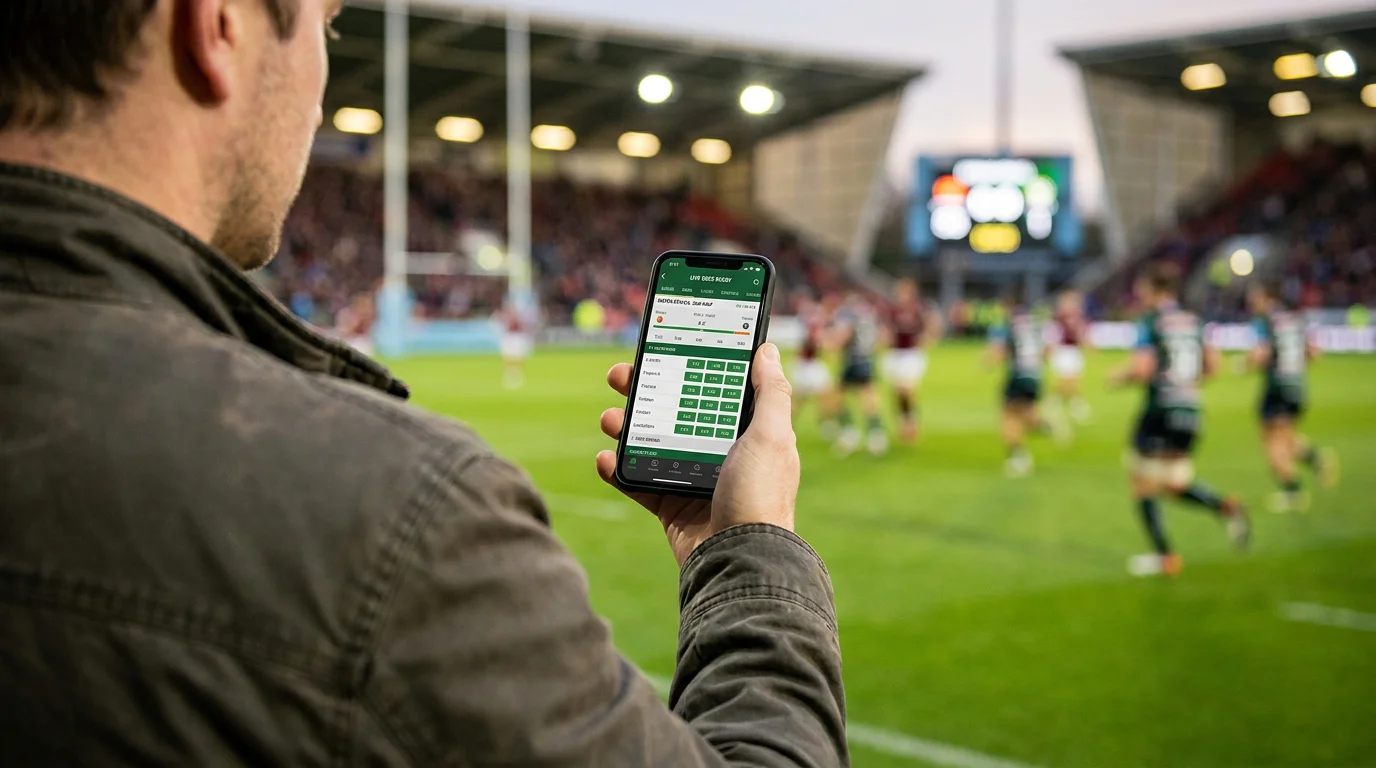
I test apps the same way I test desktop platforms – by running the same fixture on multiple devices simultaneously and noting the gaps. The best-performing apps offer dedicated rugby sections accessible from the home screen, maintain live match trackers with ball position and event timeline, and process cash-out requests within one second. The worst-performing apps don’t differentiate between Union and League in their navigation, which tells you everything about how seriously the operator takes rugby.
Live streaming availability varies significantly. Some operators stream domestic and international rugby fixtures directly through their apps, provided you have a funded account or have placed a qualifying bet. Others restrict streaming to horse racing and football. If live streaming rugby while betting in-play is part of your match-day routine, this is a feature worth verifying before committing to a platform. I maintain detailed assessments of both rugby betting apps in the UK and rugby live betting platforms, covering latency, streaming, and in-play market depth for each major operator.
UKGC Licensing and the Regulatory Landscape
UKGC Licensing and the Regulatory Landscape
ambling Commission, put it bluntly before stepping down: the next five years will be more consequential for gambling regulation than any period he’d witnessed, including his time leading the Commission. He wasn’t exaggerating. The regulatory framework governing rugby betting sites in the UK is shifting faster than at any point since the Gambling Act 2005, and every change has a direct impact on the experience you get as a punter.
The fiscal pressure on operators is intensifying. The Remote Gaming Duty and its companion remote betting duty increase – which I covered in detail in the margins section above – are projected to generate an additional GBP1.1 billion for the Treasury by 2029-30. Total gambling tax receipts for 2026-27 are forecast at GBP5 billion, a 24.8% year-on-year jump. The regulatory environment isn’t just about rules; it’s about economics, and those economics are reshaping every aspect of the betting experience from odds to promotions to responsible gambling investment.
A UKGC licence is the minimum requirement for any operator accepting bets from UK customers. It’s not a quality seal – it’s a permission slip. The licence guarantees the operator is subject to regulatory oversight, holds customer funds in segregated accounts (or has equivalent protections), and adheres to the Commission’s Licence Conditions and Codes of Practice covering advertising standards, withdrawal processing, and responsible gambling requirements.
Mandatory deposit limits – Since 31 October 2025, all UKGC-licensed operators must offer customers the option to set a financial limit before their first deposit. This isn’t optional for the operator, and it shouldn’t be treated as optional by the bettor either. Setting a limit costs nothing, creates a ceiling you can adjust later, and is the simplest form of bankroll discipline available. If your chosen operator doesn’t prompt you to set a limit during registration, they’re in breach of their licence conditions – and that tells you something about how seriously they take compliance across the board.

For punters, the practical implications are straightforward. Only bet with operators holding a current UKGC licence – verifiable in under a minute on the Gambling Commission’s public register. Be aware that the tax environment is increasing costs for operators, and those costs will filter through to your experience via margins and promotions. Pay attention to how an operator handles its regulatory obligations: the bookmaker that makes responsible gambling tools easy to find is the same bookmaker that takes compliance seriously across its entire operation, including odds accuracy and payout reliability.
Responsible Gambling Tools and Resources
Responsible Gambling Tools and Resources
ipline I’d apply to any financial activity, and I expect the same from anyone reading this page. The Gambling Survey for Great Britain paints a clear picture of who bets on sport in this country: about 10% of the UK adult population participates in online sports betting, with a significant gender gap – 16% of men versus 4% of women. Those numbers matter because they tell us that sports betting is mainstream, not marginal, and the tools designed to keep it safe need to be taken as seriously as the tools designed to find value in the odds.
Every UKGC-licensed rugby betting site must provide a set of responsible gambling tools. The question isn’t whether they exist – they do, because they’re a licence condition – but whether you’re using them. In my experience, most recreational bettors set up an account, skip every prompt, and start placing bets without engaging any protective features. That’s a mistake. The tools are there because they work, and they cost you nothing to activate.
Before you place your next rugby bet
- Set a deposit limit: weekly or monthly, matching what you can afford to lose entirely without affecting your finances or wellbeing
- Set a session time limit or reality check: a prompt that interrupts your betting at a set interval (60 minutes is a reasonable starting point) to show net position and time spent
- Review your bet history at least monthly: look for patterns – increasing stake sizes, chasing losses after a bad weekend, betting on competitions you don’t follow
- Know where GamStop is: the free national self-exclusion scheme covers all UKGC-licensed operators simultaneously for a minimum of six months – if you need a break, this is the fastest way to enforce it
- Keep betting and personal finances separate: a dedicated betting account funded by bank transfer, not linked to a credit card (which is prohibited for UK gambling anyway), creates a clear boundary
- Talk to someone if betting stops being enjoyable: the National Gambling Helpline operates 24 hours and provides free, confidential support

I’ll be direct about my own approach: I have a weekly deposit limit that I’ve never raised in the middle of a losing run. I review my P&L spreadsheet on the first Monday of every month. If the numbers are red for two consecutive months, I take a two-week break from all rugby betting. These aren’t heroic measures; they’re basic financial hygiene applied to an activity that involves real money and real emotional responses.
Frequently Asked Questions
Frequently Asked Questions
What are the best rugby betting sites in the UK?
The best rugby betting site depends on how you bet. If you focus on match results and handicaps, prioritise operators with the tightest margins on those specific markets – measurable by calculating the implied probability overround on a live fixture. If live betting is your focus, test in-play odds refresh speed during an actual match. If bonuses matter, calculate the effective real value after wagering requirements rather than relying on headline figures. No single operator dominates every dimension, which is why serious rugby bettors maintain accounts with multiple UKGC-licensed bookmakers.
Is rugby betting legal in the UK?
Rugby betting is fully legal in the UK when conducted through operators licensed by the UK Gambling Commission under the Gambling Act 2005. The UKGC regulates all forms of sports betting, including online, mobile, and in-shop wagering on both rugby union and rugby league. You can verify any operator’s licence status on the Gambling Commission’s public register. Betting with unlicensed operators is not illegal for the punter, but it removes all regulatory protections – including fund segregation, dispute resolution, and responsible gambling requirements – which makes it a risk not worth taking.
What types of bets can you place on rugby?
The core markets available on most rugby fixtures include match result (which team wins), handicap (a virtual points advantage applied to one side), total points over/under (whether the combined score exceeds a set line), tryscorer (first, anytime, or last to score a try), winning margin (the band within which the final margin falls), and outright markets (tournament or season-long wagers like Six Nations winner or top tryscorer). Higher-profile fixtures carry additional markets including half-time/full-time, player points, team-specific props, and bet builder options that combine multiple selections from the same match.
What is the difference between rugby union and rugby league betting?
The two codes differ in squad size (15 versus 13), scoring values (union tries are worth 5 points, league tries are worth 4), and match tempo. These differences produce meaningfully different betting landscapes. Union matches tend to be lower-scoring, with tighter handicap lines and more reliance on set-piece dominance. League matches generally produce higher totals, wider handicap spreads, and more predictable try-scoring patterns. Market depth also varies: the Premiership and Six Nations attract heavy bookmaker investment in Union, while Super League and the NRL drive League volumes. Applying Union handicap logic to League fixtures, or vice versa, is a common and costly mistake.
How do handicap bets work in rugby?
A handicap bet applies a virtual points adjustment to one team before the match starts. If you back a team at -7.5 on the handicap, they need to win by 8 or more points for your bet to win. If you back the opposing team at +7.5, they can lose by up to 7 points and your bet still lands. The half-point (0.5) eliminates the possibility of a push (tie on the handicap). Bookmakers offer multiple handicap lines on the same fixture – a tighter line at shorter odds, or a wider line at longer odds – allowing you to calibrate risk and reward. In league matches, handicap lines tend to be wider due to the sport’s higher scoring rate and larger margins of victory.
What is the best rugby betting app in the UK?
The best rugby betting app is the one that performs fastest during the moments that matter – when you’re placing an in-play bet during a match and every second of latency affects the price. I evaluate apps on four functional criteria: odds refresh speed during live rugby (under 2 seconds is the benchmark), one-tap bet placement from the in-play view, cash-out execution reliability, and whether the app offers a dedicated rugby section rather than burying the sport under a generic alphabetical list. Live streaming availability is a differentiator too, though not all operators stream rugby fixtures through their apps. Test any app on a live match before trusting it with meaningful stakes.
How can I bet responsibly on rugby?
Start with the tools every UKGC-licensed operator is required to provide: deposit limits (set before your first deposit), session time reminders, and access to GamStop for national self-exclusion. Beyond the basics, maintain a dedicated bankroll separate from personal finances, review your betting history monthly to spot patterns like escalating stakes or chasing losses, and take a break if betting stops being enjoyable. The Gambling Survey for Great Britain shows that 10% of the UK adult population bets on sport online – this is a mainstream activity, and treating it with the same financial discipline you’d apply to any other spending decision is the most effective form of responsible gambling.
Created by the ”Rugby Betting Sites” editorial team.