Rugby Betting Odds: How to Read Decimal, Fractional and American Formats
 Available in US
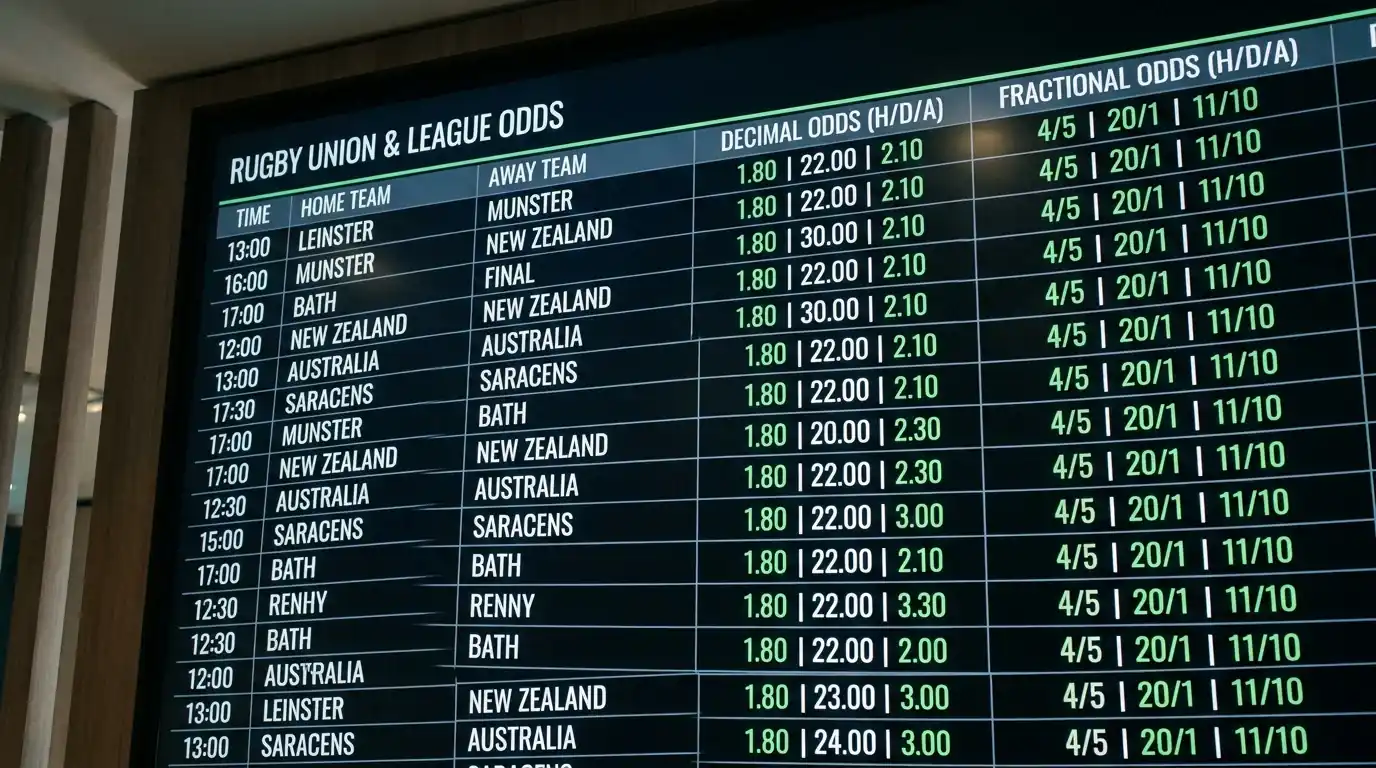
I spent my first six months betting on rugby unable to properly read fractional odds. I understood that 5/1 meant five pounds profit on a one-pound stake, but anything more complex – 11/8, 4/6, 100/30 – left me reaching for a calculator every time. Switching to decimal odds in 2016 was the single most practical improvement I made to my workflow, because it let me compare prices across bookmakers in seconds instead of minutes. The format you use matters less than your ability to convert between them and extract the one number that actually drives decisions: implied probability.
Three Odds Formats and How to Convert Between Them
Roughly 290 million online bets are placed every month in the UK, and those bets are priced in three formats depending on the bookmaker and the bettor’s preference. Understanding all three is non-negotiable if you’re serious about finding value.
Decimal odds are the simplest. The number represents your total return per unit staked, including the stake itself. Odds of 2.50 mean a one-pound bet returns two pounds fifty – one pound fifty profit plus your original pound back. To convert fractional to decimal, divide the numerator by the denominator and add one. So 3/2 becomes (3 divided by 2) plus 1 = 2.50. To convert decimal to fractional, subtract 1, then express the result as a fraction: 2.50 minus 1 = 1.50, which is 3/2 or equivalently 6/4.
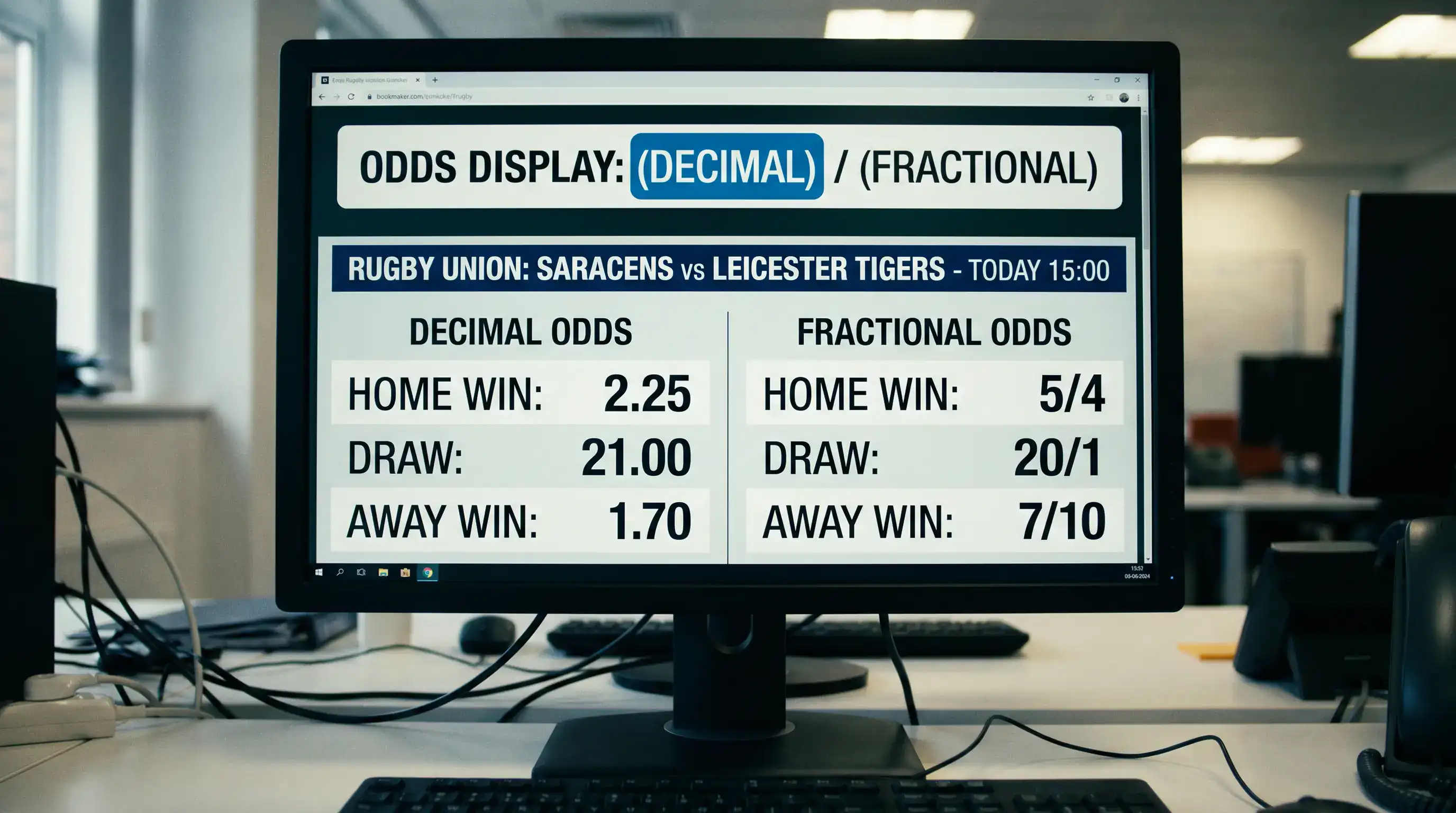
Fractional odds, the traditional UK format, express profit relative to stake. Odds of 3/1 mean three pounds profit for every one pound staked. Odds of 1/3 mean one pound profit for every three pounds staked – the shorter the fraction, the heavier the favourite. The awkwardness of fractional odds is that comparing 11/8 with 6/4 requires mental arithmetic that decimal format eliminates: 11/8 is 2.375, 6/4 is 2.50. The second price is clearly better.

American odds are rarely used in UK rugby betting but appear on some international platforms. Positive American odds show profit on a 100-unit stake: +250 means 250 profit on 100 staked. Negative odds show how much you need to stake to profit 100: -150 means you stake 150 to win 100. To convert positive American to decimal, divide by 100 and add 1: +250 becomes 3.50. For negative, divide 100 by the absolute value and add 1: -150 becomes 1.667.
I keep a conversion table pinned to my desk for the fractional oddities – 11/10, 6/5, 5/6, 8/11 – that come up repeatedly in rugby match odds. But day to day, I work exclusively in decimal, and I’d recommend the same to anyone building a rugby betting system. The fewer translation steps between the odds on screen and the probability in your head, the faster you can spot value.
Calculating Implied Probability from Rugby Odds
Every odds format encodes a probability, and extracting it is the foundation of every value bet I’ve ever placed. The calculation in decimal format is: implied probability = 1 divided by the decimal odds. Odds of 2.00 imply a 50% probability. Odds of 3.00 imply 33.3%. Odds of 1.50 imply 66.7%.
The critical insight is that the sum of implied probabilities across all outcomes in a market always exceeds 100%. That excess is the bookmaker’s margin – the built-in advantage that guarantees the operator profit over time. In a standard rugby match-result market with home win, draw, and away win priced at 1.60, 21.00, and 2.80, the implied probabilities are 62.5% + 4.8% + 35.7% = 103.0%. The 3.0% excess is the margin.

I use implied probability for every decision. If my model assigns a 60% chance to a home win and the bookmaker’s implied probability is 55% (odds of 1.82), the gap between my estimate and theirs is the expected value. Over time, consistently backing outcomes where your assessed probability exceeds the implied probability is the only sustainable path to profit in rugby betting.
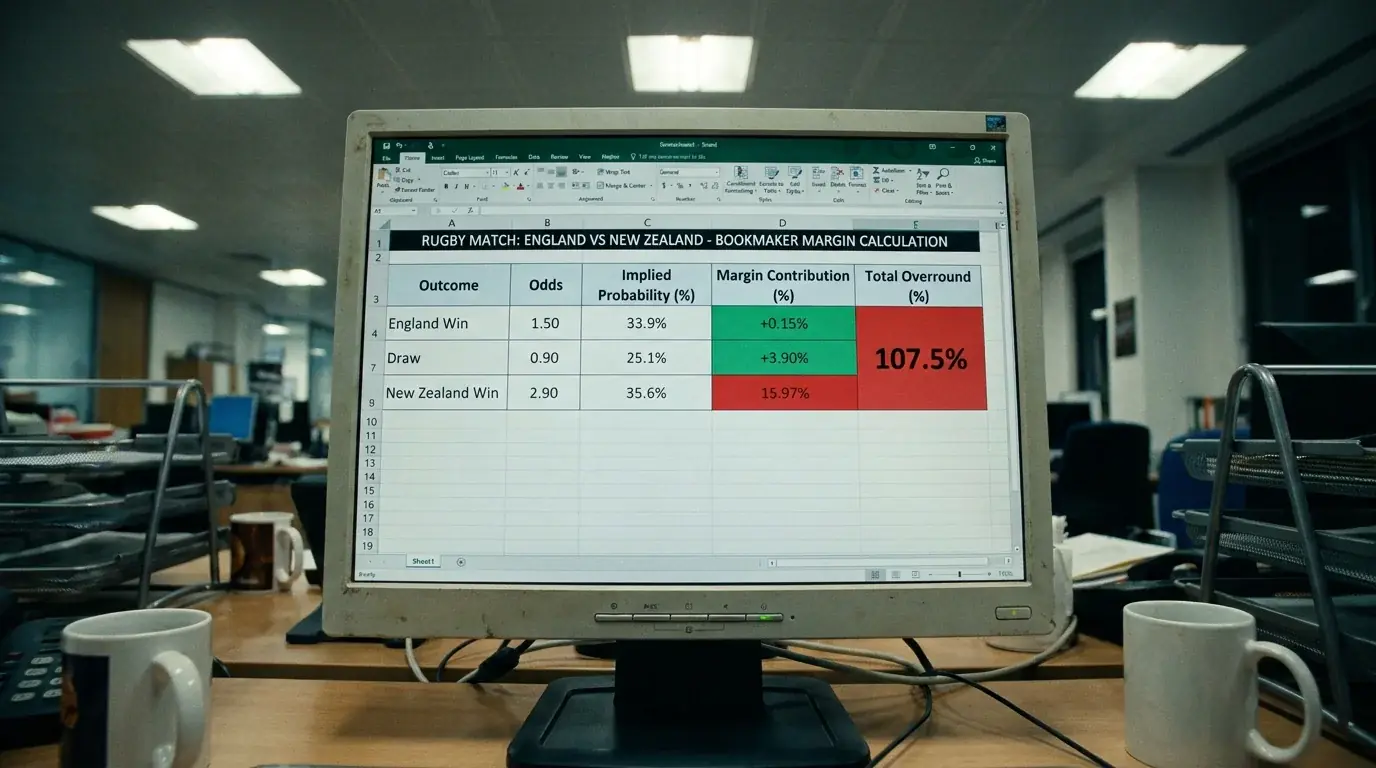
The mechanics of how margins work across different market types – match result, handicap, totals – deserve a detailed treatment of their own. The short version is that margins vary significantly depending on the market and the competition: a Six Nations match-result market might carry a 3% margin, while a first tryscorer market on the same fixture could carry 30% or more.
What Causes Rugby Odds to Shift Before and During a Match
I opened a Premiership match-result market on a Monday morning last season and noted the home side priced at 1.72. By Thursday afternoon, the same selection was 1.58. No injury news, no squad announcements, no obvious public information – just price movement. That movement was driven by sharp money: professional bettors who had identified value at 1.72 and backed it heavily enough to force the bookmaker to shorten the price.
Understanding why odds shift is as important as reading them. The primary drivers are: team news (confirmed starting XVs, late withdrawals, tactical changes), weather forecasts (especially for total points and handicap markets), betting volume (large stakes from respected accounts move the line), and market correction (bookmakers adjusting to align with the broader market consensus). Live betting makes this process continuous – over 30% of UK sports bets are now placed in-play, and rugby odds update every time a significant event occurs: a try, a card, a penalty, a substitution.
My approach to pre-match odds movement is to set alerts at the price I consider value and wait. If the odds drift beyond my target, I back immediately. If they shorten past my value threshold, I move on. Chasing a price that’s already moved against you is a discipline failure that erodes long-term returns. The odds are a conversation between the market and the bookmaker, and your job is to listen, not to argue.

The one exception is team-news-driven movement. When a key player is ruled out and the odds shift by three or four ticks in an hour, the market often overshoots. I’ve tracked 40-plus instances of fly-half absences in the Premiership over the past five seasons, and the average odds movement overestimates the on-field impact by roughly 8 to 12%. That systematic overreaction is a reliable source of value – but only if you have a model that can estimate the actual impact rather than relying on gut feel.
How do rugby betting odds work?
Rugby odds represent the payout for a winning bet and encode the bookmaker’s assessment of probability. In decimal format, odds of 2.50 mean a total return of 2.50 per unit staked. The implied probability is calculated as 1 divided by the odds. The sum of implied probabilities across all outcomes exceeds 100%, with the excess representing the bookmaker’s built-in margin.
Why do rugby odds change before kick-off?
Odds shift due to team news announcements, weather forecast changes, sharp betting volume from professional bettors, and market correction as bookmakers align with consensus pricing. The most dramatic movements occur when a key player is confirmed absent, which can move match odds by 3 to 5 ticks within hours.
Created by the ”Rugby Betting Sites” editorial team.